
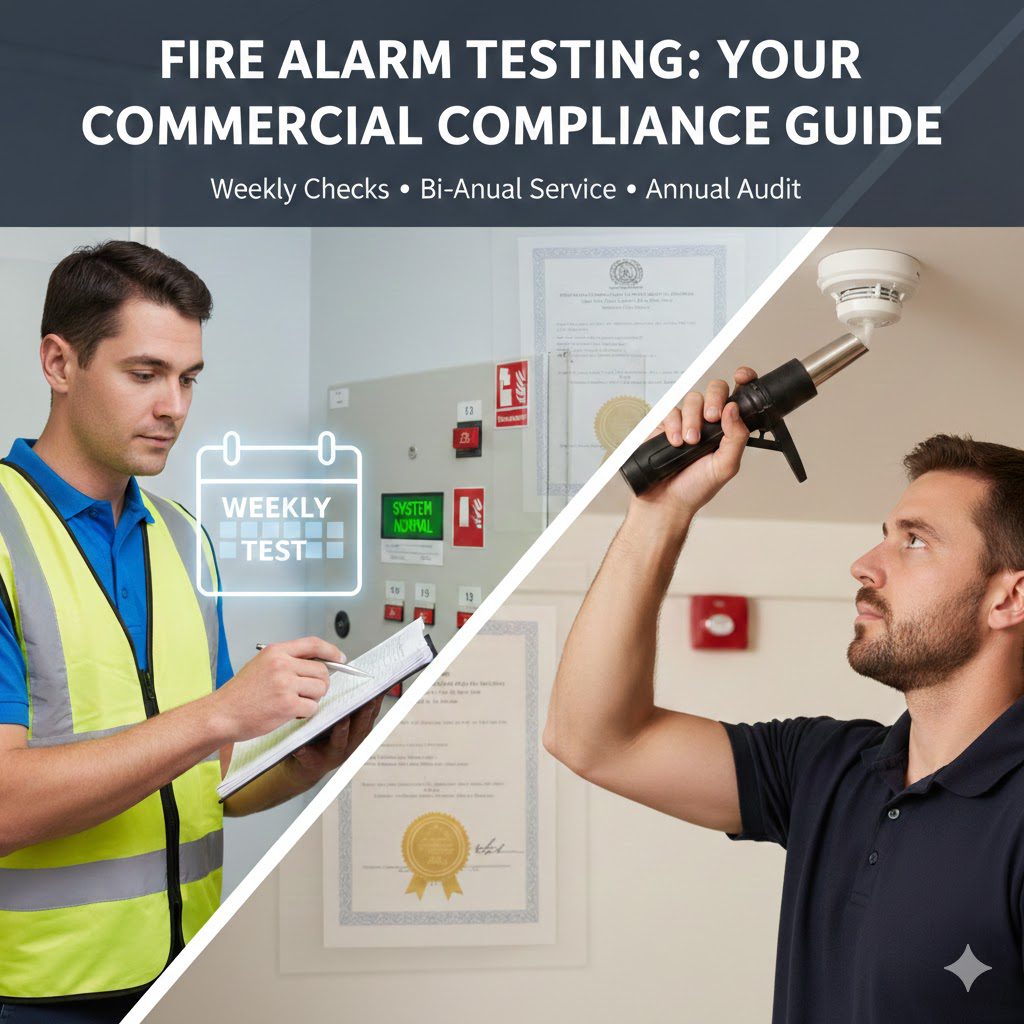
This question keeps facilities managers awake at night, usually right after they have suddenly remembered they cannot recall the last time someone actually tested their fire alarm. The answer is not “once a year” or “when we remember to do it,” and getting it wrong can result in significant legal or regulatory penalties with fire safety inspectors, insurance companies, and potentially the courts.
The Weekly Test Everyone Ignores
You are supposed to test your fire alarm every single week. Not monthly. Not quarterly when the maintenance company visits. Weekly.
Before you panic, this is not a full test of the entire system. You pick a different manual call point (those little break glass units) each week and activate it. The alarm sounds, you check that sounders are working, you reset the system, and you write it down in your fire safety logbook.
The process takes approximately ten minutes, but it is amazing how many businesses just do not do it. We have turned up to sites where the logbook has not been filled in for months, sometimes years. When we ask who is doing the weekly tests, we get blank looks.
The reason for weekly testing is simple. Fire alarms can develop faults between professional inspections. A sounder might fail. Wiring could get damaged during building work. A detector could get painted over by decorators. The weekly test gives you an early warning that something is not right, rather than discovering your alarm is broken during an actual fire.
You need to rotate which call point you test each week. Keep a record of which one you tested, the date, the time, any issues found, and who did the test. This logbook is the first thing fire safety inspectors want to see.
The Six-Monthly Professional Service
Twice a year, you need a qualified fire alarm engineer to service your system. This is not something you can do yourself with a YouTube video.
During a six-monthly service, we test the entire system much more thoroughly than your weekly call point test. Every detector gets checked. Every sounder. Every interface with other systems. We are looking at battery backup capacity, checking control panel programming, testing remote monitoring connections if you have them, and making sure the system can actually detect different types of fire.
We are also looking for physical damage, checking that detectors have not been painted or covered, verifying that sounders can still be heard throughout the building, and making sure any building alterations have not created blind spots where fires could start undetected.
The six-monthly service picks up gradual degradation you would not spot with weekly tests. Detectors get dusty and less sensitive. Batteries lose capacity. Connections corrode. These things happen slowly, but they are the difference between a system that works when you need it and one that fails at the worst possible moment.
The Annual Full System Test
Once a year, your fire alarm needs a complete going over. This is more comprehensive than the six-monthly service and includes full battery discharge tests to confirm your backup power will actually last the required duration during a power failure.
We are also updating system software if needed, checking compliance with current standards, verifying that your system still meets the requirements of your fire risk assessment, and making sure any changes to your building over the past year have not compromised fire safety.
This annual service is when we catch the big issues. Systems that need upgrading because they are obsolete. Zones that need reconfiguring because you have changed how you use your building. Additional detectors needed in new areas.
Between Professional Visits
You cannot just book the six-monthly services and think you are done. Between professional inspections, you are responsible for monitoring your system. Check the control panel regularly for fault indicators. Investigate any unexplained alarms rather than just resetting and forgetting. Keep detectors clear of dust. Make sure call points are not obstructed. Report any issues immediately.
If you have a monitored system connected to an alarm receiving centre, check that the monitoring connection is active. We have seen cases where the monitoring connection has failed and nobody noticed for months because they were not checking the panel.
Building work triggers additional responsibilities. If contractors are working near detectors or call points, you need to manage that. Dusty work can trigger false alarms or clog detectors. We have had situations where builders have disconnected parts of the system to stop false alarms, then forgotten to reconnect everything.
Different Buildings, Different Rules
The testing frequency varies depending on what type of premises you have. Schools need to test more frequently because they are occupied by children. Care homes have additional requirements because residents might need assistance evacuating. High risk industrial sites might need monthly professional inspections rather than six-monthly.
Your fire risk assessment should specify what testing regime your particular building needs. If you have not had a fire risk assessment done recently, or if your building use has changed, this must be addressed immediately..
What Happens If You Don’t Comply
You are breaking the law. The Regulatory Reform (Fire Safety) Order 2005 requires you to maintain fire safety equipment, and that includes regular testing. Fire safety inspectors can issue enforcement notices, prohibition notices, or prosecute you. Fines can run into tens of thousands of pounds.
Your insurance is another problem. Most commercial insurance policies require you to maintain fire safety systems to specific standards. If you have a fire and it turns out your alarm had not been tested and serviced as required, your insurer can refuse to pay out. You could lose everything because you did not spend the cost of servicing.
Then there is the moral side. If someone dies or gets seriously injured in a fire and your alarm did not work because you had not maintained it, you have got to live with that. The legal consequences would be severe, but the personal guilt would be worse.
Records That Actually Matter
Documentation is not just about satisfying inspectors. Good records help you spot patterns. If you are getting frequent false alarms from one zone, that tells you something needs investigating. If battery tests are showing declining capacity, you can plan a replacement before the batteries fail completely.
Your records should include weekly test logs with dates, times, call points tested, and any issues found. Six-monthly service reports from qualified engineers detailing all tests carried out and any faults found. Annual service reports with comprehensive system reviews and any recommendations. Records of any false alarms, what triggered them, and what was done. Any modifications to the system, including dates and who did the work.
Keep these records for at least the lifetime of your current system. They are invaluable if there is ever a fire, an insurance claim, or legal action. They also help the next engineer who services your system understand its history.
When to Ring Us Immediately
Between your scheduled services, certain situations mean you need an engineer out now. If your fire alarm panel is showing fault warnings that do not clear when you reset, call us. If you are getting frequent false alarms from the same detector or zone, that needs investigating. If sounders are not working during your weekly test, that is an emergency. If you have had building work that might have affected the system, get it checked before you assume everything is still working.
Do not wait for your next scheduled service if something seems wrong. A fire alarm that is partially working is potentially more dangerous than no system at all, because you might be relying on protection that is not actually there.
Fire alarm testing is not one of those jobs you can cut corners on or put off. The weekly tests take minutes. The professional services cost less than most people’s monthly coffee habit. The potential cost of not doing them, whether in fines, insurance problems, or actual lives, is massive. Set up a testing schedule, stick to it, keep decent records, and sleep better knowing your fire alarm will actually work when you need it to.
No responses yet