
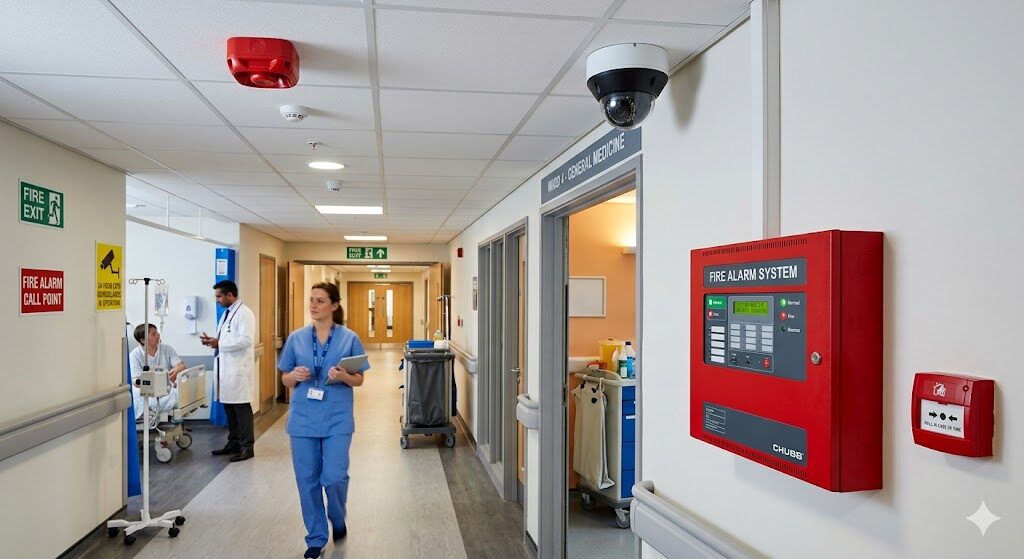
Care homes, clinics, GP surgeries and other healthcare settings operate under a level of responsibility that most businesses do not face. The people in your care are often elderly, unwell, confused, or physically unable to move without assistance. In the event of a fire, they cannot simply walk out of the building. Your staff will be doing it for them, one resident at a time, under pressure, in the middle of the night if that is when it happens to occur.
That reality shapes everything about how we approach fire alarm design in healthcare settings. At 24/7 Protection we have worked with care homes, supported living facilities, dental and medical practices and other healthcare operators across Lancashire. We understand what is at stake and we design our systems accordingly
Faster detection, not just earlier warning
The standard that applies to most care homes is L1 under BS 5839, meaning detection throughout the entire building including all bedrooms, corridors, plant rooms and roof voids. The reason for this is straightforward. A fire in a resident’s bedroom at two in the morning needs to be detected immediately, not when smoke has drifted out under the door and reached a corridor detector.
We install addressable systems that identify the exact device that has activated. When a detector in room fourteen goes off at three in the morning, your night staff do not need to guess where the fire is. They know. That ten or fifteen seconds of certainty makes a real difference when you are working with a skeleton team and a building full of people who need physical assistance to move.
We also work with care home operators to understand their evacuation strategy before we finalise the system design. Progressive horizontal evacuation is the standard approach in most residential care settings, where residents are moved to the adjacent fire compartment rather than out of the building entirely. The alarm system needs to support that strategy, and the zoning needs to match the compartmentation of the building. We make sure it does.
False alarms in care homes cause real harm
This is something that does not get discussed enough. In an office, a false alarm is an inconvenience. In a care home, it can be genuinely traumatic for residents. Being woken at night by a loud alarm, having to be moved or assisted out of bed, the confusion and distress that follows, the time it takes for people to settle again afterwards. The physical and psychological impact on vulnerable residents is significant.
We use multi-sensor detectors in areas where false alarms are common, combining optical smoke sensing with heat sensing to reduce nuisance activations without compromising real detection performance. In bathrooms and shower rooms we specify detectors that are resistant to steam. In kitchens we use heat detectors. The right equipment in the right place makes an enormous difference to the day-to-day experience of living and working in your building.
CCTV in care settings requires care
There is growing pressure on care home operators to install CCTV, both from regulators and from families who want reassurance that their relatives are being looked after properly. Done well, CCTV in a care setting supports good practice and provides a record that protects both residents and staff. Done badly, it raises serious concerns about privacy, dignity and data protection.
We take a considered approach to CCTV in care environments. Cameras belong in entrance areas, corridors, communal lounges, car parks and at perimeter points. They do not belong in bedrooms or bathrooms. We advise on the legal framework, help you produce a policy that satisfies both the ICO and the CQC, and make sure that the system you end up with is genuinely defensible if it is ever scrutinised.
Remote access to camera feeds allows registered managers and owners to check in on their facilities without needing to be physically present, and our monitoring packages provide out-of-hours coverage that gives additional peace of mind, particularly for smaller homes where staffing is lean overnight.
Maintenance that CQC will not question
Fire alarm maintenance in a care home is not optional and the records need to be right. CQC inspectors will ask to see your fire safety documentation, including service records for the alarm system, test logs, and evidence of any remedial work carried out. If those records are incomplete, unclear or missing, it creates a problem that goes beyond the fire safety certificate.
Our maintenance contracts include every inspection, test and call-out logged and documented in a format that is clear and easy to produce at inspection. We carry out six-monthly services as a minimum, in line with BS 5839, and we provide you with written reports after every visit. If we find something that needs fixing, we tell you what it is, why it matters and what it will cost to sort out. No surprises.
If you are a care home manager, a practice manager or a healthcare estates professional looking at your current fire alarm or CCTV provision, we would welcome the chance to talk. Call us or fill in the contact form and we will arrange a convenient time for a free survey.